Tiếng Việt




Amid the profound transformation of Vietnam’s higher education system toward enhanced institutional autonomy, modern governance standards, and deeper integration into regional and international education spaces, assuring and continuously improving educational quality in accordance with international benchmarks has become an imperative for higher education institutions. Within this context, the Vietnam Women’s Academy (VWA) organized a semina with some representatives of the international quality assurance agency to discuss strategic orientations for international accreditation of its undergraduate programmes.
The meeting was attended by Associate Professor Dr. Tran Quang Tien, President of the Vietnam Women’s Academy, together with leaders of faculties, departments, and affiliated institutes. Representing FIBAA was Dr. Nina Rotermund provided insights into accreditation frameworks and evaluation criteria. The discussion was further enriched by the participation of Associate Professor Dr. Nguyen Phuong Nga, Director of the Center for Education Accreditation under the Vietnam Association of Universities and Colleges, who shared practical insights and experiences related to quality assurance and accreditation in the Vietnamese context.
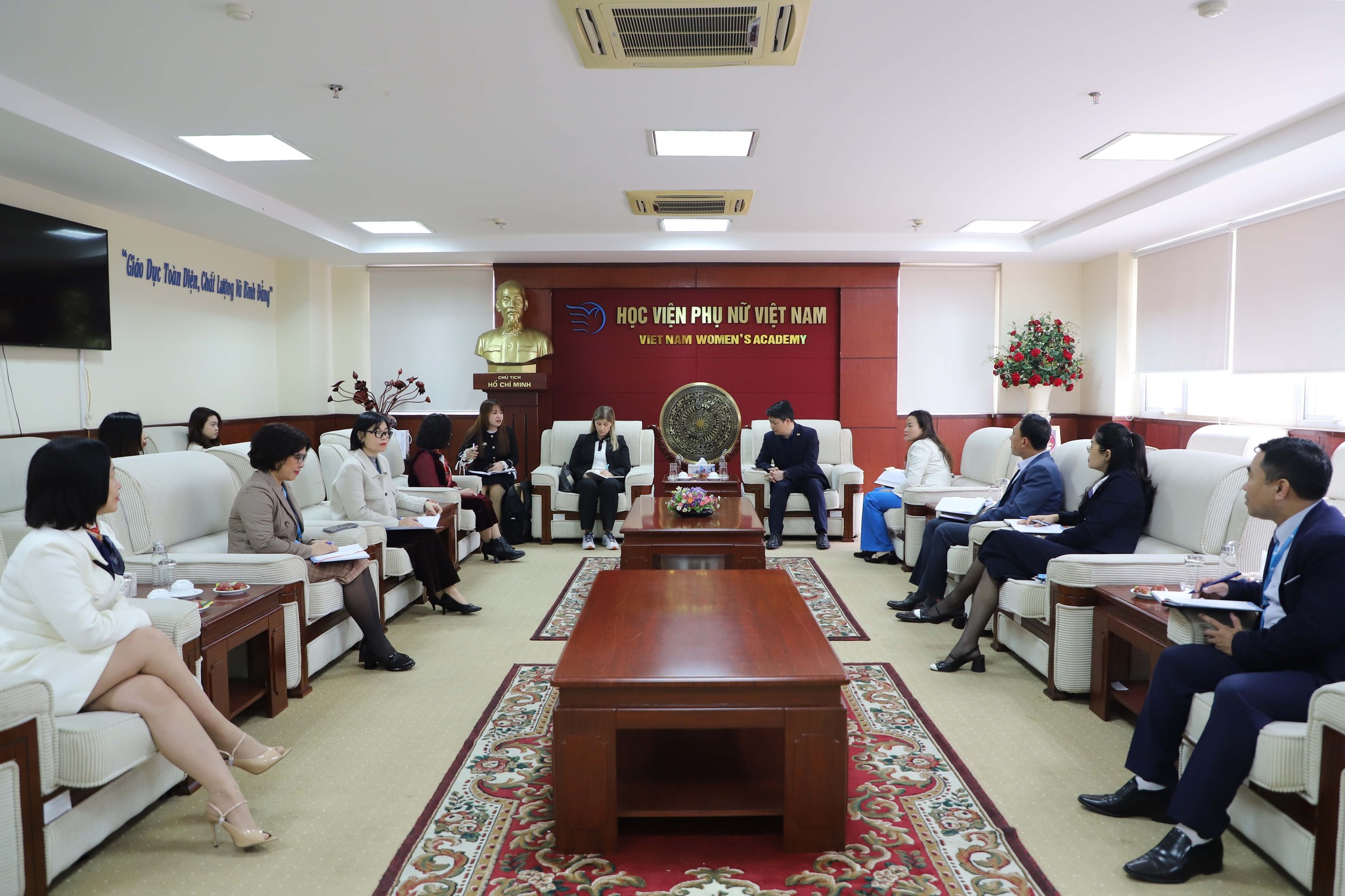
During the meeting, Associate Professor Dr. Tran Quang Tien provided an overview of the Academy’s history, functions, and development orientation. Originating as a training institution for women cadres, VWA has gradually expanded into undergraduate and postgraduate education and scientific research, with the aim of developing into a multidisciplinary higher education institution with a distinct identity closely associated with women, gender, and sustainable development.
Drawing on its 52-year legacy of the Central Women Cadres School and 13 years of institutional development, the Academy has consistently regarded educational quality as its core value. Quality assurance has been pursued through continuous curriculum review and updating, pedagogical innovation, faculty capacity development, and the strengthening of internal quality assurance mechanisms. According to the President, pursuing international accreditation – a strategic step toward translating the Academy’s commitment to quality enhancement into a concrete, systematic, and sustainable process. International accreditation, he emphasized, is not merely about obtaining a certificate, but rather a long-term partnership that contributes to strengthening university governance capacity, enhancing transparency and accountability, and fostering a culture of quality across the institution.