Tiếng Việt




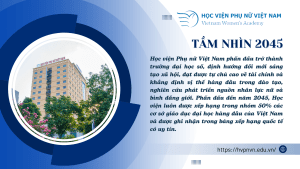
Amid profound transformations in Vietnam’s higher education system, the Vietnam Women’s Academy (VWA) stands at a critical juncture in its institutional development. This moment represents both the continuation of achievements accumulated over more than a decade of growth and a strategic opportunity to restructure in response to emerging national priorities and global trends. The Development Strategy of the Vietnam Women’s Academy for the period 2026 -2030, with a vision to 2045, has been formulated within this context. More than a conventional management plan, the Strategy serves as a strategic manifesto that articulates the Academy’s long-term orientation as a specialized higher education institution committed to gender equality, social innovation, and sustainable development.
Changing Contexts and New Expectations for Higher Education
The strategic direction of the Vietnam Women’s Academy is embedded within a rapidly evolving international and domestic environment. Globally, universities are increasingly challenged by complex and interrelated issues such as climate change, widening social inequalities, population ageing, geopolitical instability, and the accelerated development of digital technologies, particularly artificial intelligence. These dynamics are reshaping expectations of higher education institutions, which are now required not only to produce technically competent graduates but also to cultivate global citizenship, ethical awareness, and responsible innovation. Universities are thus called upon to function as centers of knowledge creation, social engagement, and policy-relevant research in an increasingly digitalized world.
At the national level, Vietnam’s higher education reforms are being guided by a series of major policy frameworks issued by the Party and the State. Notable among these are Resolution No. 29-NQ/TW on the fundamental and comprehensive reform of education and training, along with key resolutions adopted in 2025 concerning science and technology, innovation, and university autonomy. These policies have established a new institutional environment characterized by increased accountability, competitiveness, and autonomy. Within this context, the Vietnam Women’s Academy has clearly identified that strengthening governance capacity, enhancing academic quality, and expanding social impact are essential conditions for consolidating its position within the national higher education system.
Institutional Foundations and Strategic Continuity
Established in 2012 through the upgrading of the Central Women Cadres Training School, the Vietnam Women’s Academy has undergone more than thirteen years of development across two five-year strategic cycles. During this period, the Academy has achieved notable progress in education and training, scientific research, digital transformation, and the gradual advancement toward financial autonomy. These achievements have laid a solid foundation for the formulation of a more ambitious and forward-looking strategy for the next phase of development.
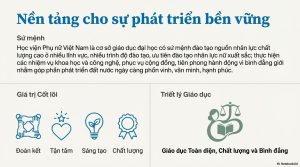
The 2026–2030 Strategy, with a vision extending to 2045, builds upon the Academy’s mission, core values, and educational philosophy while integrating modern governance approaches such as the Balanced Scorecard (BSC) and Key Performance Indicators (KPIs). The application of these tools is intended to ensure strategic coherence, transparency, and measurability, thereby enhancing the feasibility and effectiveness of implementation.
Positioning as a Digital University Oriented Toward Social Innovation
A defining feature of the Strategy is the positioning of the Vietnam Women’s Academy as a digital university with a strong orientation toward social innovation. By 2045, the Academy aspires to achieve a high level of financial autonomy, consolidate its leadership in education and research related to women’s human resource development, and progressively gain recognition in reputable international university ranking systems. This positioning reflects a strategic choice aimed at enhancing institutional competitiveness, resource mobilization, and academic credibility.
Importantly, the pursuit of international recognition is not an end in itself, but a means to strengthen the Academy’s capacity to fulfill its distinctive social mission. As a higher education institution under the Vietnam Women’s Union, the Academy is uniquely positioned to pioneer initiatives that advance gender equality, empower women, and promote inclusive social development. The digital university model is therefore conceived as an enabling framework that integrates technology, innovation, and social responsibility.
Strategic Objectives toward 2030 and Core Development Pillars
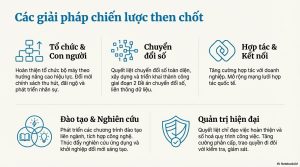
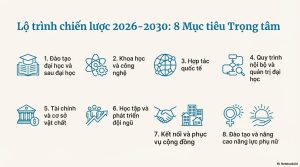
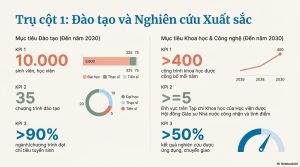
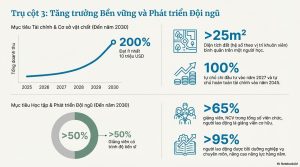
For the period 2026–2030, the Academy has set the strategic objective of fully meeting the standards required for a higher education institution authorized to offer doctoral programs. Concurrently, it aims to maintain its position within the top 50 percent of Vietnamese universities and to begin participating systematically in international ranking frameworks. Education and training at both undergraduate and postgraduate levels are identified as central pillars of development, with a projected student population of approximately 10,000 learners.
The Strategy emphasizes the diversification of academic programs, with priority given to applied and interdisciplinary fields related to digital technologies, artificial intelligence, and social sciences relevant to women’s development. These programs are designed not only to respond to labor market demands but also to contribute to the formation of high-quality women’s human resources capable of leadership and innovation in various sectors.
In the domain of science and technology, the Academy aims to become a leading national research center on women and gender equality. Strategic targets include increasing the volume and quality of research projects, expanding international publications, and ensuring that a significant proportion of research outcomes are applied or transferred to education, policy formulation, and community-based initiatives. This orientation underscores the Academy’s commitment to research that generates tangible social value.
Internationalization, Governance Reform, and Social Outreach
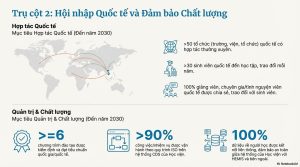
International cooperation is identified as a critical mechanism for enhancing academic quality and institutional reputation. The Academy seeks to establish and maintain active partnerships with at least 50 international universities, research institutes, and organizations, ensure the participation of international experts across undergraduate programs, and effectively leverage external technical and financial resources.
At the same time, the Strategy places strong emphasis on modernizing university governance through comprehensive digital transformation, adherence to quality assurance standards, and the effective implementation of university autonomy. Investments in infrastructure, digital libraries, expanded training facilities, and faculty development are prioritized, with the proportion of lecturers holding doctoral degrees targeted at approximately 40 percent.
Notably, the Strategy dedicates a distinct pillar to education, training, and capacity building for women beyond formal degree programs. Through short-term courses and support services, the Academy aims to reach at least 5,000 women annually, thereby contributing directly to gender equality in economic participation, political engagement, and family life.
Conclusion
In sum, the Development Strategy of the Vietnam Women’s Academy for the period 2026–2030, with a vision to 2045, represents a comprehensive and forward-looking roadmap for institutional growth. It reflects a strong commitment to innovation, academic quality, and social responsibility, while positioning the Academy to respond proactively to national and global challenges. In an era when higher education is increasingly recognized as a key driver of sustainable development, this strategic orientation demonstrates the Vietnam Women’s Academy’s readiness to enter a new phase of development with confidence, autonomy, and international integration.