Tiếng Việt




The year 2026 is anticipated to represent a significant transition in Vietnam’s higher education admissions system, following the release of a draft revision of the Regulations on University Admissions by the Ministry of Education and Training (MOET). The proposed amendments have attracted wide attention from students, parents, and higher education institutions, as they are expected to directly influence admission strategies, program selection, and the organization of institutional recruitment plans.
According to the draft Regulations on University Admissions 2026, MOET aims to enhance fairness, transparency, and quality assurance in student intake while reducing unnecessary pressure on candidates. Several important changes have been introduced across admission methods, subject combinations, bonus points, and preference registration.

The 2025 admissions counseling booth of the Vietnam Women’s Academy at the Admissions Counseling Day held at Hanoi University of Science and Technology.
Admission Based on Upper Secondary School Academic Records
For admission based on upper secondary school academic records (transcripts), institutions will calculate scores using the cumulative grade point average of six semesters from Grades 10, 11, and 12. A minimum of three subjects must be included in the selection combination, among which Mathematics or Literature is compulsory and must account for at least one-third of the total score on a 30-point scale.
Candidates applying through this method are required to achieve a minimum score of 16/30 in the corresponding three subjects of the upper secondary school graduation examination. This requirement does not apply to candidates granted special consideration or exemption from the national examination. For majors subject to admission thresholds jointly regulated by relevant ministries, applicants using academic records must attain a minimum score of 20/30.
Admission Methods and Bonus Points
Each higher education institution may apply up to five admission methods, including examination-based admission, selection-based admission, or combined approaches, excluding direct admission. This provision aims to streamline admission practices and prevent excessive diversification of methods that may disadvantage applicants.
Applicants may receive bonus points for achievements such as national academic awards, international Olympiad participation, special talents, or possession of international certificates. However, total bonus points are capped at 3 points on a 30-point scale, with each bonus category limited to a maximum of 1.5 points. This adjustment seeks to ensure equity and avoid disproportionate advantages.
Subject Combinations and Foreign Language Certificates
Admission combinations based on graduation examination results must consist of at least three subjects aligned with program requirements. Mathematics or Literature is mandatory and must play a central role in the scoring structure.
For candidates exempted from the Foreign Language component of the graduation examination, institutions may convert international foreign language certificates into equivalent scores according to unified guidelines issued by MOET. The draft Regulations continue to refine provisions related to foreign language certificates and admission incentives to maintain consistency and quality control.
Registration of Admission Preferences
Under the revised framework, each applicant may register a maximum of ten admission preferences across one or multiple institutions. Preferences must be arranged in descending order of priority, replacing the previously unrestricted registration practice. For teacher education programs, only preferences ranked from first to third will be considered. This change is intended to reduce system overload and encourage more deliberate decision-making by applicants.
Expanded Eligibility
The revised Regulations expand eligibility for university admission to include students enrolled in vocational upper secondary education, in line with the amended Law on Vocational Education. This policy adjustment broadens access to higher education and supports lifelong learning pathways.
Educational experts emphasize that applicants and families should closely monitor the official Regulations once promulgated, as final provisions may differ from the draft. According to Professor Nguyen Tien Thao, Director General of the Department of Higher Education, these reforms are designed to strengthen fairness, transparency, and accountability, while safeguarding applicants’ rights and improving overall admission quality.
Proposed Admission Plan of the Vietnam Women’s Academy
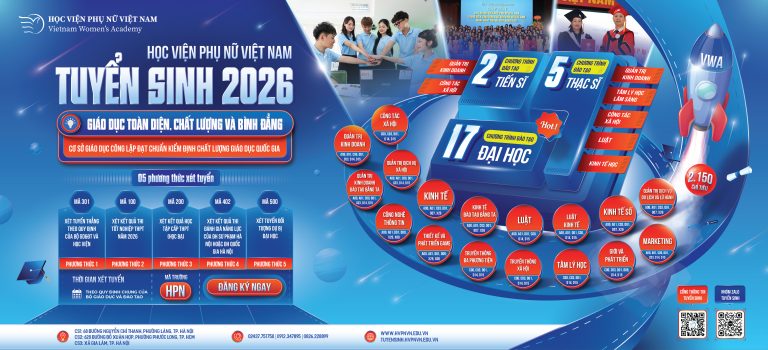
In preparation for the 2026 admission cycle, the Vietnam Women’s Academy (VWA) has announced its proposed recruitment framework, aligning institutional strategies with national policy reforms. As a multidisciplinary higher education institution committed to human resource development, VWA plans to conduct admissions at undergraduate, master’s, and doctoral levels.
At the undergraduate level, the Academy will offer 12 majors with diverse program options, including standard programs, application-oriented and specialized tracks, and English-taught programs in selected economics and management disciplines. These programs are designed to enhance graduates’ professional competence and adaptability in an increasingly globalized labor market.
Undergraduate majors include Information Technology, Social Work, Economics, Digital Economy, Marketing, Business Administration, Tourism and Travel Services Management, Law, Economic Law, Psychology, Gender and Development, and Multimedia Communication. Curricula emphasize practical relevance, professional skills development, and experiential learning.
At the postgraduate level, VWA plans to enroll master’s students in multiple disciplines and doctoral candidates in Social Work and Business Administration, contributing to the development of advanced research and management capacities.
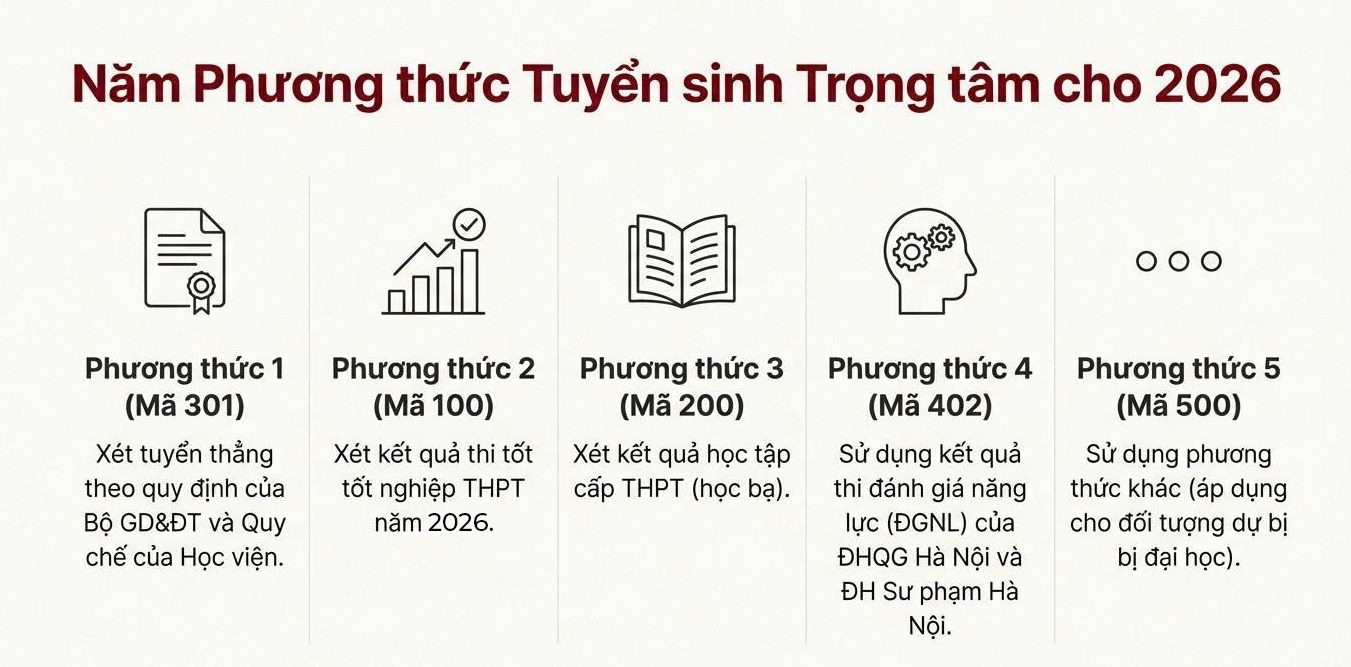
To accommodate diverse learner profiles, VWA intends to apply multiple admission methods in compliance with national regulations, including direct admission, admission based on graduation examination results, academic records, competency assessment examinations organized by leading universities, and specialized pathways for pre-university learners.
Key Recommendations for Applicants
In light of the anticipated changes to the 2026 admission framework, applicants are advised to closely follow the official Regulations once issued by MOET, develop early and realistic study plans, prepare application documents carefully, and select admission preferences aligned with personal strengths and career aspirations.
Overall, the 2026 university admission season is expected to demand greater proactivity and strategic planning from candidates. While the revised framework opens new opportunities, it also requires applicants to make informed and well-considered decisions as they approach the transition to higher education.

———————————
CONTACT
Học viện Phụ nữ Việt Nam: số 68 Nguyễn Chí Thanh, Phường Láng, TP. Hà Nội.
Website: http://hvpnvn.edu.vn/; Email: tuyensinh@hvpnvn.edu.vn;
Fanpage: https://www.facebook.com/TUYENSINHHOCVIENPHUNUVN;
Điện thoại: 0243.7751750; 0912.991.355